
Crazy Time RTP Explained: Average Return to Player, RTP Percentage, Net Gaming RTP, and Volatility Impact
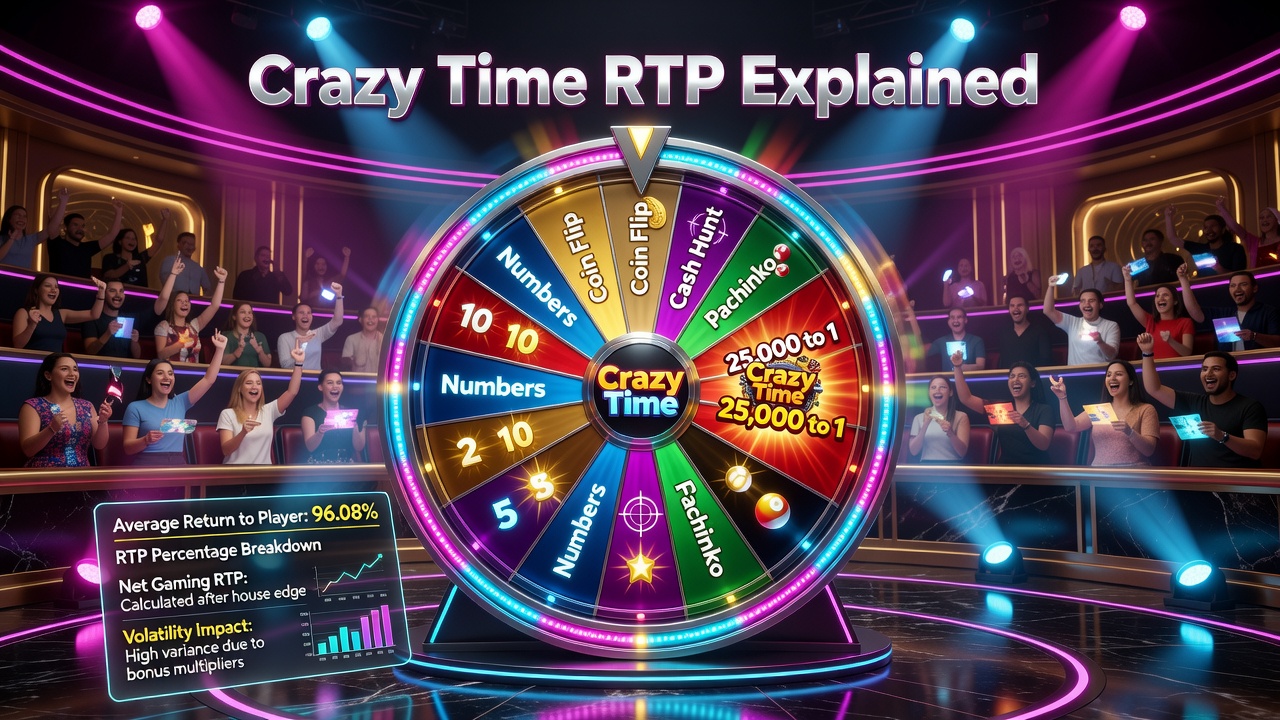
A single spin of the Crazy Time wheel can pay out at 25,000 to 1 on a Coin Flip bonus, yet the mathematics behind that possibility have almost nothing to do with your odds on any given round. Players chase the flashy multipliers and forget that the number governing their long-term outcome sits quietly in the background: the return to player percentage. That figure, not the size of any single win, determines whether a betting strategy holds up over thousands of spins.
Evolution's live game show format complicates the picture further, because Crazy Time doesn't operate like a standard slot with one static payout table. Each betting spot - Numbers, Coin Flip, Cash Hunt, Pachinko, Crazy Time - carries its own distinct return figure, and the game's structure of top slots and bonus multipliers means the theoretical percentage shifts depending on where you place your chips. Anyone asking what is the rtp of crazy time needs to understand that there isn't one answer, but a range tied to specific bet types. Ignoring that nuance leads to misplaced expectations and poorly sized bankrolls.
This piece breaks down what the RTP percentage actually measures, how net gaming RTP differs from the theoretical figure quoted in game guides, and why volatility - not just the average return - dictates how your sessions will actually feel. Understanding all three pieces together gives you a realistic framework for playing smart rather than chasing a number in isolation.
What RTP Really Means in Crazy Time
Return to player is a long-run statistical average, not a promise about any individual session. It represents the percentage of all wagered money that a game is mathematically designed to pay back to players over an extremely large number of rounds - typically modeled across millions of simulated spins. A game with a 95% RTP theoretically returns 95 cents for every dollar wagered, with the remaining 5 cents constituting the house edge.
The Theoretical Return to Player Formula
The formula itself is simple: total winnings paid out divided by total amount wagered, expressed as a percentage. What complicates Crazy Time is that this calculation must be run separately for each bet type, since the wheel's segment distribution and bonus game outcomes create different payout profiles depending on where a player places their stake.
Why RTP Is Not a Short-Term Guarantee
Across ten or even a hundred spins, actual returns can deviate wildly from the theoretical average. RTP only converges toward its stated figure across sample sizes large enough to smooth out variance - a threshold no individual player will realistically reach in a single sitting. This is precisely why a solid grasp of Crazy Time RTP should inform bankroll planning rather than short-session expectations.
How Live Game Shows Calculate RTP Differently Than Slots
Traditional slots generate RTP from a fixed reel and paytable configuration baked into the software. Crazy Time, as a live wheel-based game show, derives its RTP from the physical or digital wheel's segment layout combined with the mathematical models governing its four bonus rounds. The presence of a live host and physical wheel doesn't change the underlying probability engine - it's still governed by a certified random distribution, just presented through a broadcast format.
Crazy Time Average Return to Player by Bet Type
This is where most players get tripped up. Crazy Time offers eight betting positions, and each one carries a meaningfully different average return.
Numbers Bets (1, 2, 5, 10)
The four number segments carry the lowest volatility and the most stable returns among all betting options. Because these segments appear most frequently on the wheel, they pay out more often but at lower multipliers, producing a Crazy Time average return to player that sits toward the higher end of the game's overall range.
Bonus Games (Coin Flip, Pachinko, Cash Hunt, Crazy Time)
The four bonus segments appear far less frequently on the wheel, which naturally raises variance. Their average returns tend to run slightly lower than the best-performing number bets, though the top-end multipliers available inside these bonus rounds can produce outsized individual wins that skew perception of their overall value.
Comparing Bet Types Side by Side
- Number bets: highest hit frequency, lowest per-spin volatility, most predictable session flow
- Coin Flip: moderate variance, capped multiplier ceiling relative to other bonuses
- Pachinko: higher variance, occasional flat-bet segment adds unpredictability
- Cash Hunt: consistent bonus structure with a defined multiplier range across all targets
- Crazy Time bonus: highest ceiling multiplier, lowest appearance frequency, greatest single-spin swing
Crazy Time Slot RTP Percentage: Industry Standards and Benchmarks
Live game shows generally publish RTP figures in the 94-96% range, and Crazy Time sits within that band depending on which bet is examined. This places it in line with mainstream slot and live casino products, though direct comparison requires care given the structural differences.
How Crazy Time Compares to Standard Slot Machines
Conventional online slots frequently advertise RTPs anywhere from 92% to 98%, with high-profile titles often clustering near 96%. Crazy Time's blended figure across all bet types generally lands in a comparable zone, meaning the Crazy Time slot RTP percentage is neither unusually generous nor unusually stingy relative to the wider market.
Regulatory Disclosure Requirements
Licensed operators are required to publish RTP information for certified games, and reputable platforms display this data per bet type rather than as a single blended number. Regulators in most major jurisdictions mandate independent testing of the random number generator and wheel mechanics before certification, giving the published figures a verifiable basis rather than a marketing claim.
Where to Verify Official RTP Figures
The most reliable source for exact figures is the game's official information panel, typically accessible through the in-game menu, alongside the provider's published game rules documentation. Third-party statistics from licensed operators can supplement this but should never replace the certified figures issued by the game studio itself.
Net Gaming RTP Crazy Time: What Actually Reaches Players
Theoretical RTP and net gaming RTP are related but distinct concepts, and conflating them causes real confusion among players trying to evaluate their odds.
Theoretical RTP vs. Actual Player Returns
Theoretical RTP is a mathematical projection based on the game's design. Net gaming RTP reflects what players collectively received back over a specific, finite period of real-world play - a figure influenced by the actual distribution of outcomes during that window, including any statistical clustering of high or low results. Over a long enough timeframe, net gaming RTP should converge toward the theoretical figure, but short-term reporting periods can show meaningful deviation.
How Operators Report Net Gaming Figures
Some jurisdictions require operators to publish net gaming RTP data drawn from actual wagering activity across their platform, distinct from the manufacturer's theoretical certification. This creates a useful cross-check: if net gaming RTP tracks consistently close to the theoretical figure across large volumes of play, it confirms the game is behaving as designed.
Why the Distinction Matters for Serious Players
Players who only look at theoretical RTP miss half the picture. Net gaming RTP data, when available, offers real evidence of how a game has performed for actual wagers rather than a projection. Comparing the two figures builds a more grounded understanding of what to expect, rather than relying purely on manufacturer-supplied theory.
Crazy Time Slot Volatility RTP: How Risk Shapes Your Sessions
RTP tells you how much a game returns on average. Volatility tells you how that return is distributed - smoothly across many small wins, or unevenly through rare large payouts punctuated by long dry stretches. Both figures need to be read together.
Defining Volatility in the Context of Crazy Time
Volatility measures the size and frequency of swings around the average return. A low-volatility bet pays smaller amounts more often; a high-volatility bet pays large amounts rarely, with extended losing stretches in between. Crazy Time slot volatility RTP considerations differ sharply by bet type because of the uneven segment distribution on the wheel.
High-Volatility Bets: Bonus Rounds and Top Multipliers
The bonus games, particularly Crazy Time itself, carry the highest volatility in the game. Landing on this segment is rare, but the potential multiplier - amplified further by the flapper mechanism that can multiply results several times over - creates the possibility of enormous single-spin payouts. This high ceiling comes paired with long stretches where the bonus simply doesn't hit.
Low-Volatility Bets: Numbers and Steady Play
Number bets offer a smoother ride. They land frequently enough that bankroll depletion happens more gradually, and small, regular wins offset losses more consistently than the boom-or-bust pattern of bonus rounds. Players prioritizing session length over jackpot chasing tend to favor this steadier approach.
Matching Volatility to Your Bankroll and Playing Style
A modest bankroll paired with high-volatility bets is a fast route to running out of funds before a big multiplier ever lands. Conversely, a player with substantial capital and tolerance for long losing streaks may find the occasional outsized bonus payout worth the wait. Aligning bet selection with both bankroll size and personal risk tolerance matters more than chasing the single highest theoretical return figure.
Practical Strategies Based on RTP and Volatility Data
Understanding the numbers only pays off if it changes how you actually place bets.
Balancing Bet Types for Session Longevity
Splitting stakes across number bets and one or two bonus segments is a common approach for extending playtime while retaining upside exposure. This blended structure smooths out the volatility of bonus rounds with the steadier hit rate of number bets.
Bankroll Management Around High-Variance Bonuses
Setting a strict portion of your bankroll aside specifically for high-volatility bets - and treating losses on those bets as an accepted cost of chasing bigger multipliers - prevents a single bad stretch from ending a session prematurely.
Reading RTP Data Before You Play
Checking published RTP and volatility information for each bet type before committing real funds turns guesswork into an informed decision. Players who skip this step often misjudge their odds based on a recent hot or cold streak rather than the underlying math.
Frequently Asked Questions
Does Crazy Time have one single RTP percentage?
No. Each bet type - Numbers, Coin Flip, Pachinko, Cash Hunt, and Crazy Time - has its own distinct theoretical return figure. There is no single blended RTP that applies uniformly across every bet on the table.
Which bet type in Crazy Time has the best average return?
Number bets, particularly the higher-frequency segments, typically post the strongest theoretical returns due to their consistent hit rate. Bonus rounds can pay far more on individual spins but generally show a slightly lower average return across large sample sizes.
Is a higher RTP always better for a player?
Not necessarily. A high RTP paired with high volatility means fewer, larger wins with long losing stretches, which doesn't suit every bankroll or play style. Matching RTP with your tolerance for variance matters as much as the raw percentage itself.
How often does net gaming RTP match the theoretical RTP?
Over very large volumes of real-world play, net gaming RTP tends to track closely with the theoretical figure. Over shorter reporting windows, natural statistical variance can cause noticeable, temporary gaps between the two.
Can volatility change the actual RTP of a bet?
No, volatility and RTP are separate measures. RTP defines the average return over time, while volatility describes how unevenly that return is distributed across individual sessions. A bet's theoretical RTP stays fixed regardless of how volatile its outcomes appear.
Where can I find verified RTP figures for Crazy Time?
The most reliable source is the official in-game information panel provided by the game's operator or the studio's published rules documentation. Licensed platforms are required to disclose certified RTP data, making this a more dependable source than informal player estimates.